"EDUCATION"
Verbit vs MuseTree: The Honest Comparison
"The High-Stakes Transcription Engine: Inside Verbit’s Hybrid Stack"
Picture this: You’re sitting in a high-stakes legal deposition or a board meeting where every syllable carries the weight of a potential lawsuit. The room is a chaotic symphony of overlapping voices, heavy accents, and industry-specific jargon that would make a standard LLM have a total meltdown. In my eight years of bootstrapping tech products, I’ve learned that "good enough" transcription is usually just a fancy word for "useless." When you need 99.9% accuracy, you don't just need an algorithm; you need a system that knows when to ask a human for help.
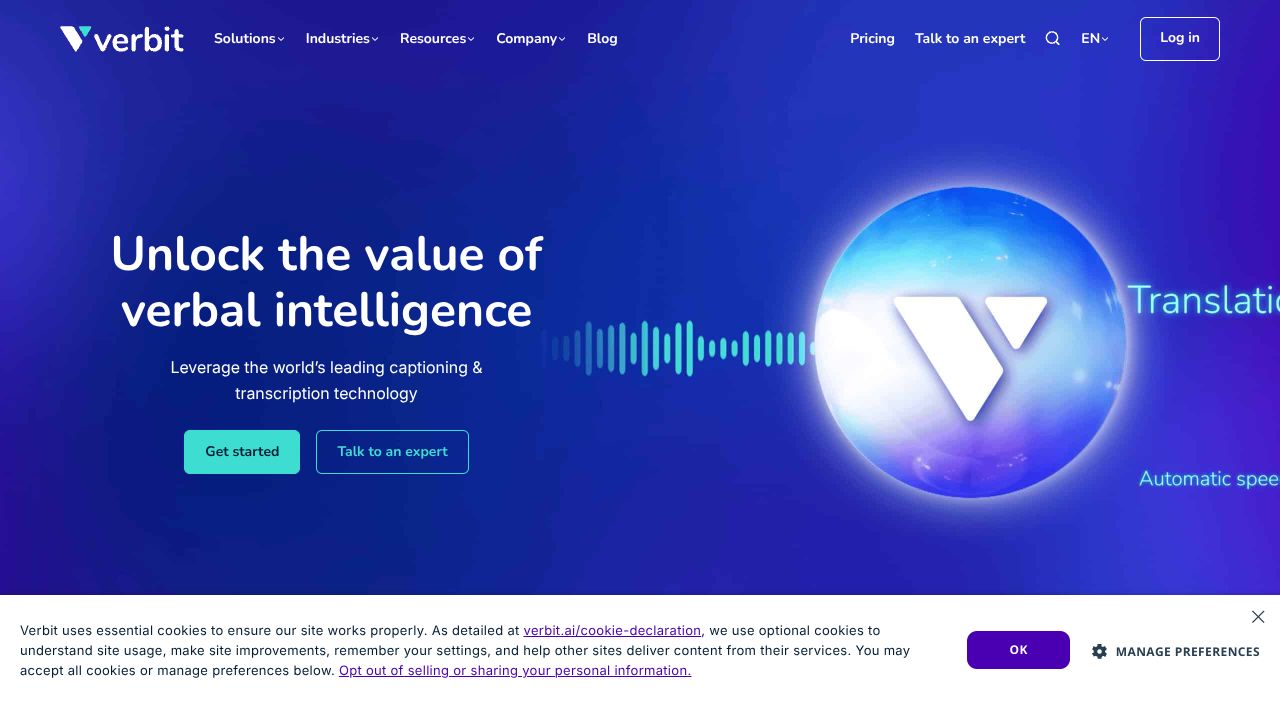
Verbit is that system. At its core, Verbit isn't just another speech-to-text API; it’s a sophisticated orchestration layer that blends Neural Machine Learning with a global marketplace of human editors. While many of the Daily Drops we see focus on pure-play AI, Verbit’s design philosophy leans into the "Human-in-the-Loop" (HITL) model to solve the "last mile" accuracy problem that plagues regulated industries like law, education, and corporate compliance.
"Architecture & Design Principles"
Verbit’s architecture is built on a dual-layer processing pipeline. The first layer utilizes proprietary Automated Speech Recognition (ASR) engines—specifically tuned for various acoustic environments and domain-specific vocabularies. Unlike a general-purpose tool like Notta, which is fantastic for the rapid-fire pace of internal team meetings, Verbit’s engine is designed to handle "messy" audio with high reverberation or complex terminology.
The second layer is the "Adaptive Hybrid" component. Once the ASR generates a draft, the system uses a proprietary algorithm to identify "low-confidence" segments. These segments are then routed to human transcribers in real-time. This isn't just a simple hand-off; it’s a sharded workflow where multiple editors can work on different sections of a single file simultaneously, ensuring that even a two-hour deposition can be turned around with near-perfect accuracy in a fraction of the time. This scalability is achieved through a robust microservices architecture that handles massive bursts in data volume without latency spikes.
"Feature Breakdown"
Core Capabilities
- →Hybrid AI-Human Sync: The platform uses a sophisticated "Confidence Score" for every word generated. If the AI dips below a certain threshold, the human layer is triggered. This is crucial for legal professionals who need court-ready documents where "can" and "can't" are never confused.
- →Real-Time Captioning (38+ Languages): Verbit uses a low-latency streaming protocol to provide live captions. For educational institutions, this is a massive accessibility win, providing a level of linguistic depth that is much more specialized than the creative, hobbyist-focused AI tools like MuseTree.
- →Smart Formatting & Templates: The system doesn't just spit out a block of text. It applies speaker identification and custom templates (like legal headers or academic citations) automatically, saving hours of manual post-processing.
Integration Ecosystem
Verbit’s integration strategy is clearly aimed at the enterprise. It features deep hooks into Video Management Systems (VMS) like Kaltura, Panopto, and Brightcove, as well as the standard Zoom/Teams/Webex trifecta. For developers, their REST API is well-documented, allowing for automated file uploads and webhook-based notifications once the "human-verified" transcript is ready. It’s a "set it and forget it" workflow that fits perfectly into a larger DevOps or content production pipeline.
Security & Compliance
In my experience, this is where Verbit leaves the "prosumer" tools in the dust. They aren't just playing around with basic encryption; we’re talking HIPAA, SOC 2 Type 2, and GDPR compliance. Data is encrypted at rest and in transit, and their human editor network operates under strict NDAs with platform-level permissions that prevent any single editor from seeing the full context of sensitive files if necessary.
"Performance Considerations"
Verbit is a heavyweight. While it isn't as "instant" as a pure AI tool like Notta for the final verified version, its speed-to-accuracy ratio is unmatched. You can get a rough AI draft immediately, but the verified 99% accurate version typically drops in hours, not days. From a resource perspective, because it’s a cloud-native SaaS, the heavy lifting is offloaded from the client side, making it accessible via any web portal or API call.
"How It Compares Technically"
When we look at the Education and First Looks categories, the differences are stark. MuseTree is an incredible example of AI used for creative pedagogy—helping users understand music theory through generative models. It’s about creation. Verbit, conversely, is about documentation.
While Notta is my go-to for quick interview transcriptions because of its mobile-first ease of use and instant processing, it lacks the specialized legal formatting and the human-verification layer that Verbit provides. If you’re a startup founder recording a quick brainstorm, use the former. If you’re a university provost ensuring ADA compliance for 5,000 hours of lecture content, Verbit is the only logical choice.
"Developer Experience"
Working with Verbit’s API feels like it was built by people who actually spend time in an IDE. The documentation is clean, and the ability to specify "Profile" (e.g., Legal vs. Medical) via API parameters allows for much better initial ASR results. They also offer robust SDKs that handle the heavy lifting of multi-part file uploads, which is a blessing for anyone who has ever wrestled with 2GB video files and timeout errors.
"Technical Verdict"
Verbit is the "Enterprise Grade" solution in a sea of "GPT-wrappers." My Hot Take: Most startups don't need this level of precision, but for those that do (LegalTech, EdTech, MedTech), it is an absolute infrastructure requirement. Its strength lies in its hybridity—using AI to do the bulk of the work and humans to ensure the "Drop Review" never finds a flaw. It’s expensive, with enterprise seats reaching into the $30k+ range, but when you consider the cost of a legal misstep or a compliance failure, it’s a bargain.
Anika’s Recommendation: Stick to the lightweight tools for your internal scrums, but if you’re shipping a product where the data must be right, Verbit is the gold standard. Now, if only I could get an AI to play my favorite board games with me while I wait for these transcripts to finish...
"EXTERNAL LINK"
DON'T SLEEP ON THIS DROP